Introduction
When your report cards arrive, it seems as though everyone asks you the same question: “What will you do now?” Even as you hear this from relatives, you are looking at many internet pages with information about courses you will be able to take.
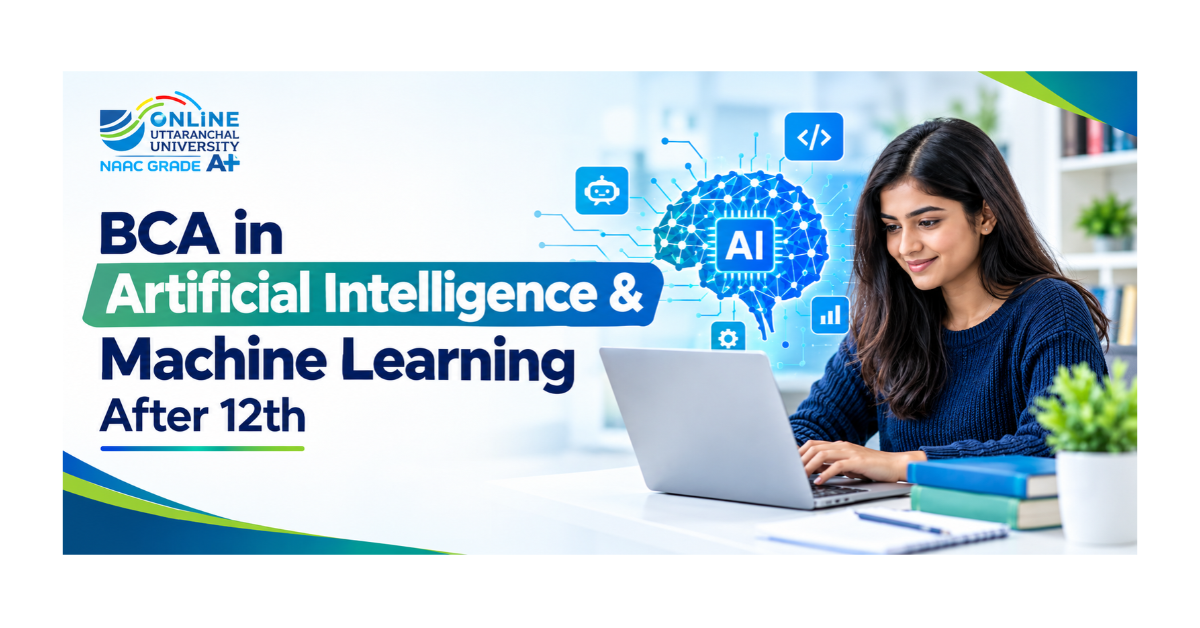
If working with computers interests you or you wish to study the reasons behind what makes your online shopping experience easy, one of the IT courses can be of value to you. There is a wide range of choices available for you to take starting from general courses in computers to some specialized programs such as BCA in Artificial Intelligence and Machine Learning.
This article will describe one of the courses. Here, you will know about the course and its content. You will also learn who will be able to apply, how students will practice their knowledge gained during class sessions, and what the graduates will do after completing it.
Get Free Counseling
What is BCA in artificial intelligence and machine learning?
BCA stands for Bachelor of Computer Applications. It is a degree that has a duration of three years and teaches students the process of writing, testing and using software.
The AI and ML version makes use of the computing foundation and adds a specialisation to it. AI is the ability of the machines to perform tasks usually done by humans such as identifying a person’s voice or understanding photos. Machine learning is one of the subfields of AI where the system learns patterns from the previous data, rather than applying a pre-defined set of rules.
How programming, applications, and AI/ML fit together
Think of a kitchen. Programming is acquiring the skills needed to learn how to cook food. Computer applications are the compiled meals. AI and ML is the skill of tasting thousand of recipes and predicting what a new customer will want.
The development of a learning model necessitates coding, just as the training of such a model requires the input of data, thus making the basics of the course the starting point.
Programme snapshot
This table shows common patterns. Confirm every detail on the page of the university you’re considering.
| Detail | General overview |
|---|---|
| Full form | Bachelor of Computer Applications with AI and ML specialisation |
| Level | Undergraduate |
| Typical duration | 3 years (6 semesters). Some universities now offer a 4-year format |
| Core focus | Programming, databases, statistics, data analytics, AI and ML basics |
| Mode | On campus, online, or blended, depending on the university |
| Who it suits | Students who enjoy logic, problem solving, and working with data |
Why consider BCA in AI and ML after Class 12?
Coding comes before models
It is not uncommon for many students want to dive head first into new trends while neglecting the elements of foundational learning in the process of doing so. This often leads to adverse results. BCA program gives one the opportunity to work on logic, programming code and learn about programming media in a systematic way before one is faced with more complex assignments. Once a solid foundation has been established, the use of complicated programs becomes manageable.
Data is the raw material
Machine learning systems are totally dependent on data inputs. It is necessary for one to collect, assemble, and read the information that was received. Because of this fact, almost all courses covering the subject of machine learning include a section on databases and analytics in addition to programming.
Early focus versus a general BCA
By choosing a specialisation right at the beginning, it gives you more time to study the subject area well. You can spend your first year studying coding before moving quickly into data and algorithms over the following years.
This is, however, not the only way to enter work in this field. It is also possible to enter AI via a normal BCA, a B.Sc. in Computer Science or a B Tech in Computer Engineering. But if you already know you want to work in this area, this will enable you to study directly for your desired career rather than going through an unrelated elective with the hope of eventually finding out the area that interest you.
What will you learn in the BCA AI and ML programme?
Typical learning stages
Every school has its own syllabus, so they can vary by institution, but this table gives the general pattern of study that you would find in most cases. Please check it against your programme.
| Learning stage | Typical subject areas |
|---|---|
| Year 1: Foundations | Computer fundamentals, programming basics, mathematics for computing, communication skills |
| Year 2: Core computing | Data structures, databases and SQL, operating systems, web basics, statistics |
| Year 3: Specialisation | Machine learning, AI concepts, data analytics, project work |
What to look for in a syllabus
When you open a university’s curriculum document, check these points:
- Whether Python is taught, since it’s widely used in ML work
- How much mathematics and statistics the programme includes
- Whether databases and analytics have lab components or only theory papers
- How many credits go to electives and projects, because that shows how much hands-on work you’ll do
If the syllabus on the website looks vague, ask the admissions office for the full semester-wise document.
Practical learning: labs, internships and the capstone project
Reading about artificial intelligence is one thing. Seeing your model make no sense at 11 p.m. and figuring out why is when the real learning happens. A good programme does a good job combining lectures with practice.
Lab sessions
Laboratories give you time to code, run, crash and fix programs, all with guidance. After a number of semesters, you are no longer the one remembering commands; you start thinking in steps.
Internships and workshops
Some universities include internships, short training programs, sessions with industry speakers, etc., while others do not, and the format differs greatly. Therefore, you should ask specific questions. Is an internship obligatory? Whether it is organized by the university or the students have to arrange it themselves? Get answers in official documents, not just in a telephone conversation with a counselor.
The capstone project
At the end of a program, you normally present a project. You will choose a real-life problem to solve which could be building a simple software to analyze customer feedback data or predict something from previous data. This experience will help you understand how theoretical knowledge is put into practice using real-life case studies. In addition, it gives some practical knowledge useful during the actual job search.
Eligibility and admission for BCA AI and ML
Admission snapshot
Each educational institution determines its own eligibility criteria which might change from year to year. The table gives basic guidelines only. The minimum required score and other requirements must be obtained from the official university documents only and not from forums or advertisements.
| Admission factor | Typical requirement |
|---|---|
| Educational qualification | Class 12 or equivalent from a recognised board |
| Subjects | Some universities ask for Maths or Computer Science. Others accept any stream |
| Minimum marks | Set by the university. Check the official notice |
| Category-specific criteria | Varies. Check the official prospectus |
| Selection process | Merit-based, entrance test, or both |
| Admission stages | Application form, document verification, fee payment |
Documents to keep ready
- Class 10 and Class 12 marksheets
- Transfer or migration certificate
- Identity proof and passport-size photographs
- Category certificate, if it applies to you
Start early. Deadlines pass faster than most people expect, and missing paperwork is a common cause of delay.
Who should think twice before choosing this course
This course isn’t for everyone, and saying so helps you more than a sales pitch would.
If mathematics is not one of your favourite subjects and you do not plan to change your approach, you are likely to face difficulties in the upcoming semester. Those who look for an easy way out in the choice of profession will be disappointed since there is no course that can provide you with guaranteed success. Finally, people interested in the term ‘AI’ should first take some introductory course in Python programming language to understand if they enjoy coding.
Career and higher education pathways after BCA AI and ML
A degree opens doors, but it doesn’t guarantee a job, a salary, or a title. Your skills, projects, and consistency decide much of what happens next.
Job roles to explore
Graduates with this background may look at roles such as:
- Junior data analyst
- Machine learning trainee or assistant
- Software developer
- Data quality or data operations associate
- AI application support roles
Many people begin in general software or analyst positions and move toward AI work as they gain experience.
Industries that use AI and ML
Medical institutions, financial structures, online stores, educational establishments, supply organizations, and mass media agencies can be among those who use these skills. Any institution processing a big volume of data can find a need for these skills.
Higher study options
Many students keep studying after a BCA. Common routes include:
- MCA (Master of Computer Applications), a direct step into deeper computing study
- M.Sc. in Data Science, AI, or Computer Science, which suits research or analytics interests
- MBA with an IT or analytics focus, for those drawn to the business side of technology
- Short certifications in cloud, data, or ML tools
Treat further study as a way to build on what you already know. It shouldn’t be a fix for a weak first degree.
How to verify what a university tells you
Brochures are written to attract applicants. Here’s a simple way to check the claims.
- Open the university’s official website and find the programme page. Compare it with what the counsellor said.
- Download the full syllabus and read the third-year subjects, since that’s where the AI and ML content sits.
- Confirm the university’s recognition status on the UGC website.
- Ask for the admission notice that lists eligibility, fees, and dates, and keep a copy.
- Talk to a current student or recent graduate if you can. A ten-minute chat often tells you more than a prospectus.
Get Free Counseling
Conclusion:
The BCA program in Artificial Intelligence and Machine Learning offers an ideology that covers all aspects of programming, data management, and problem-solving in a single three-year course. The teaching starts from the basic principles of computing, then goes on to databases and analytics, and finally, covers various aspects of artificial intelligence and machine learning through classes, laboratories, and a capstone project.
Before selecting a course, it is necessary that you do complete research. Research the syllabus completely. Find out if you qualify for the program from the official website. Get to know how much exposure you will get in practicals during the program. Now think where you will be in the next five years down the line. This answer indicates if this is the course that will work best for you or if you have to search for other IT courses after 12th
FAQs
1. What is BCA in Artificial Intelligence and Machine Learning?
It’s an undergraduate computer applications degree that adds AI and ML subjects to a base of programming, databases, and data handling.
2. Can I apply without Maths in Class 12?
It depends on the university. Some accept any stream, and others ask for Maths or Computer Science. Read the official eligibility notice.
3. Do I need coding experience before admission?
No. Most programmes teach programming from scratch.
4. Which language should I learn first?
Python is a common starting point because its syntax is readable and it’s widely used in data work. Check which language your chosen programme teaches first.
5. Is BCA AI ML available online?
Some universities offer it in online or blended mode. For online programmes, check that the university appears on the UGC-DEB list for that specific programme.
6. Is BCA AI ML better than B.Tech in IT or CSE?
Neither is better for everyone. B.Tech is a four-year engineering degree with its own entry requirements, while BCA is shorter and often more flexible. Choose based on your goals and eligibility.
7. Can I switch to data science later?
Yes, many students move toward data science through electives, projects, certifications, or a master’s degree. Your skills and portfolio matter more than the degree title.
8. Can I do an MCA after BCA AI ML?
In most cases, yes. Each university sets its own entry rules, so check them before applying.
9. Will this course get me a job?
No degree can promise that. Skills, projects, communication, and steady effort shape your path.